


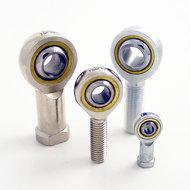
Click to enlarge
Heim Joints (Rod Ends)
Rod ends consist of an eye-shaped head with integral shank forming a housing and a standard spherical plain bearing, or a spherical plain bearing inner ring, or a spherical plain bearing inner ring and a sliding layer between the bore of the head and the inner ring. As a rule, rod ends are available with left or right-hand female or male threads. Rod ends from Rainbow have the sliding contact surface combines steel-on-bronze.
Steel-on-bronze rod ends have very wear-resistant sliding surfaces and perform well under most conditions.
Steel-on-bronze rod ends have very wear-resistant sliding surfaces and perform well under most conditions.
Heim Joint FAQs for Industrial Motion and Linkage Systems | Rainbow Precision Products
1. What is a heim joint? In what use does it apply in mechanical systems?
A heim joint is a rod end with a bearing that is made up of a sphere that gives angular movement and flexibility in alignment in linkages, control arms, steering assemblies, and industrial motions.2. What are the differences in a heim joint and ball joint in use?
The difference between a heim joint and ball joint design is primarily in the style of mounting and load where the heim joint carries the alignment of a linkage and the ball joints are generally enclosed and suspension-oriented.3. Which are the most typical heim joints that can be used in industry?
Some of the common heim joint forms in use are male and female threaded rod ends, lined and unlined versions, and corrosion resistant stainless versions suitable in the rough industrial and outdoor environments.4. What is the right choice of heim joint size?
m joint sizing: This is determined by the diameter of the bore, thread size, load rating, and the misalignment angle required to achieve safe movement control and good mechanical fit in assemblies.5. In what industry will heim joints normally be found?
The Heim Joints are commonly used in automation machinery, farm machinery, vehicle steering components as well as variable support frames where pivoting movement is needed to be controlled.6. What are the materials that are used when making a heim joint?
A typical heim joint is produced out of alloy steel, stainless steel or plated carbon steel, possibly with optional PTFE liners that allow the joint to experience less friction and less maintenance.7. What is the maximum amount of misalignment that a heim joint allows?
The capacity of the joint to misalign is based on the body design and the geometry of the ball, where in a typical situation, once the misalignment has been determined, high-misalignment spacers are used to add angular travel without straining the bearing surfaces.8. When must a joint of equipment be replaced (a heim)?
Replacement of a heim joint should be considered in case of looseness, corrosion, wearing of liners or vibrations are experienced as it is the sign of decreasing the load bearing capacity and diminishing motion precision.
Category Files
Rod ends have an eye-shaped head with a shank and a spherical plain bearing or its parts. They come with either left or right-hand female or male threads. Rainbow's rod ends use a steel-on-bronze sliding contact surface, making them very wear-resistant and reliable under most conditions.